
Frequently Asked Questions (FAQ) about Apostille
This guide provides simple explanations. For more official details, please check the Ministry of Foreign Affairs (MOFA) website.
Q. What is an Apostille?
A.
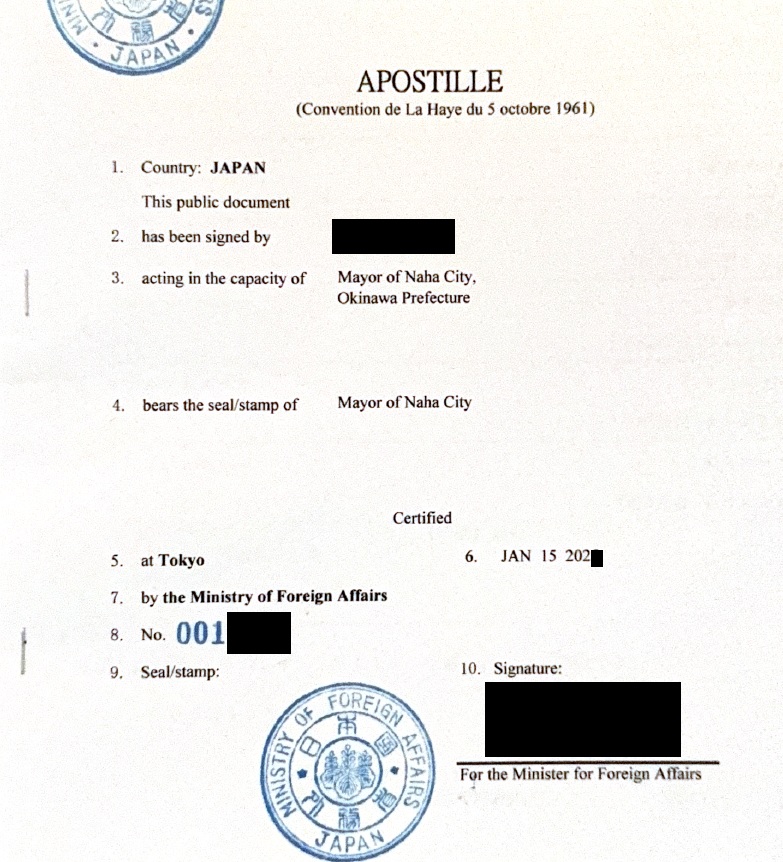
An Apostille is an 18cm x 18cm paper issued by MOFA (Ministry of Foreign Affairs). It is stapled to your official document to prove its authenticity. The text is in English. The word “Apostille” comes from French, meaning “a marginal note” or “sticker.”
Q. What are “Public Documents”?
A.
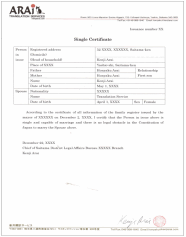
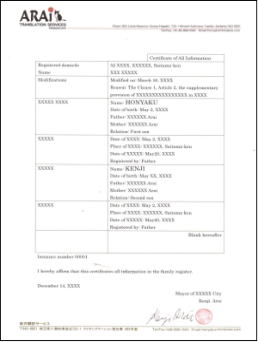
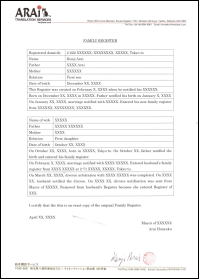
These are documents issued by the government or local city halls. Examples include: Family Register (Koseki), Certificate of Residence (Juminhyo), Marriage Certificates, Tax Payment Certificates, etc.
Q. What are “Private Documents”?
A.
These are documents NOT issued directly by the government. They cannot get an Apostille directly from MOFA (Ministry of Foreign Affairs). Examples: Private school diplomas, payslips, personal letters, company contracts, passport copies, etc.
Q. Why do I need an Apostille?
A.
When you use a Japanese document in another country, the local officials may not know if it is real. The Apostille is a guarantee from the Japanese government that the document is authentic.
Q. Is an Apostille the same as “Translation Certification”?
A.
A.
No, they are different. If you need both, the order is usually:
1. Get the Apostille from MOFA (Ministry of Foreign Affairs).
2. Translate the document.
3. Get the translation certified at an Embassy or Notary.
We can provide more details at Arai Translation Service.
1. Get the Apostille from MOFA (Ministry of Foreign Affairs).
2. Translate the document.
3. Get the translation certified at an Embassy or Notary.
We can provide more details at Arai Translation Service.
Q. Is an Apostille required for all documents?
A.
It depends on the organization or school where you are submitting the documents. We recommend checking with them directly. However, if you are submitting to a foreign government agency, it is almost always required.
Q. Can I get an Apostille on my Passport?
A.
No, MOFA (Ministry of Foreign Affairs) cannot put an Apostille directly on a passport. If you need it for a copy of your passport, you must go through a Notary Public.
Q. Can I get an Apostille by myself?
A.
Yes. You can visit MOFA (Ministry of Foreign Affairs) in person or apply by mail. Applying by mail is very common. We provide advice on how to do this for free to our translation clients.
Q. Is it difficult to get an Apostille?
A.
No, it is simple. For mail applications: Download the form, fill it out, prepare a return envelope (Letter Pack is best), and mail it with the original document to MOFA (Ministry of Foreign Affairs).
Q. How much does it cost?
A.
The Apostille itself is free of charge at the Ministry of Foreign Affairs. If you apply by mail, you only pay for the shipping/postage.
Q. I am too busy or live too far from MOFA (Ministry of Foreign Affairs). What should I do?
A.
The entire process can be done by mail. You do not need to visit the office.
Q. How many days does it take?
A.
By mail, it usually takes about 10 days in total. If you apply at the window in person, it usually takes 3-4 working days.
Q. Do I need a translation when I apply for an Apostille?
A.
No. In fact, if you attach anything (like a translation) to the original document before applying, MOFA (Ministry of Foreign Affairs) may reject your application.
Q. Can I get an Apostille for a Medical Certificate?
A.
Usually, medical certificates from private hospitals are “Private Documents” and cannot get an Apostille directly from MOFA (Ministry of Foreign Affairs). Only specific public hospitals or Red Cross hospitals are eligible. Otherwise, you must use a Notary Public.
Q. Can I get an Apostille for National University documents?
A.
Not always. Many “National Universities” are now technically “Corporations.” Documents from these universities are often treated as private. You may need to use a Notary Public first.
Q. My diploma is in a frame. Can I get an Apostille on it?
A.
If you take it out of the frame, you might be able to, but MOFA will staple the Apostille to it, which will damage your original diploma. We recommend asking your school to issue a new “Certificate of Graduation” for this purpose instead.
Q. Can I request Translation and Apostille at the same time?
A.
They are separate tasks. The standard order is to get the Apostille first, then send the completed document (original + Apostille) to us for translation.
Q. Does the Apostille page itself need to be translated?
A.
It depends on the country. For example, Ukraine/Russia almost always requires the Apostille itself to be translated into Ukrainian/Russian. Check with your Embassy.
Q. Where do I get an Apostille?
A.
In Japan, it is issued by the Ministry of Foreign Affairs (Gaimusho).
Q. Can I get an Apostille at a foreign Embassy in Japan?
A.
No. Only the Japanese government (MOFA) can issue an Apostille for Japanese documents.
Q. Can I get an Apostille for a “Public Document” at a Notary Public office?
A.
No. For official public docs (Koseki, etc.), you must use MOFA (Ministry of Foreign Affairs). Notary offices are only for private documents. (Note: Some specific Notary offices in Tokyo/Kanagawa/Osaka can handle both in a “one-stop” service for private docs).
Q. Can I use an Apostille in any country?
A.
No, it only works for countries that are members of the Hague Convention. You can find the list of member countries on the MOFA website.
Q. Can I put an Apostille on any document?
A.
No, there are rules. Generally, it must be an official document with an OFFICIAL STAMP (Actually the stamp is most important). Check the MOFA website for specifics.
Q. What if my document cannot get an Apostille, but I am asked for one?
A.
In that case, you can take your document to a Notary Public. They can create a “notarial act” which then can receive an Apostille. Please contact us for details.
Q. Is my document too old for an Apostille?
A.
MOFA (Ministry of Foreign Affairs) has a rule: the document must be issued within the last 3 months. If it is older, you need to get a new one from the city hall.
Q. Can I remove the staple from the Apostille?
A.
NEVER remove the staple. If you do, the document becomes invalid and will not be accepted.
Q. What does an Apostille actually prove?
A.
It certifies the authenticity of the official seal (stamp) on the document. It does NOT certify the contents of the document itself.
Q. Can the Ukraine/Russia Embassy certify my translation without an Apostille?
A.
Usually, no. For countries like Ukraine or Russia, the Japanese public document MUST have an Apostille first. Otherwise, the Embassy will reject your translation certification request.